
Author: Osman Zukić | Photographer: Almir Kljuno
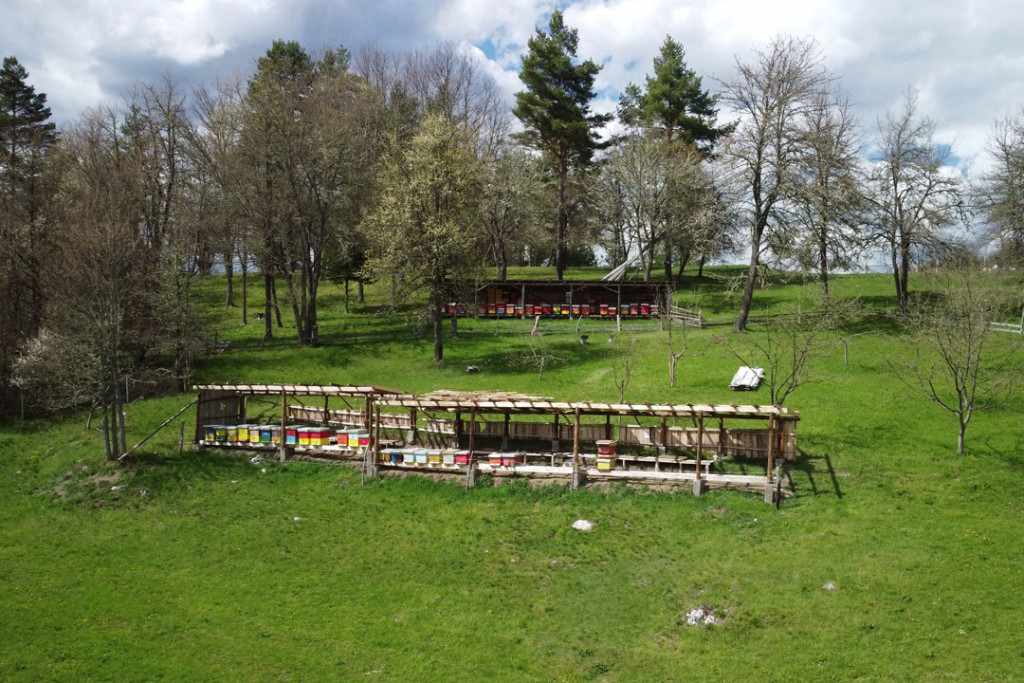
Almir Hadžiabdić welcomed us at his apiary in Dolovi, near Olovo. He will later say that this is the place where his soul resets to factory settings. He has been keeping bees for almost 30 years. He first started when he was in his early twenties, after emerging from a war, in which he had served as a minor, into a world where every perspective was blurred.
The apiary is situated approximately 800 meters above sea level. There are no acacias here, nor other early bee forage. At this altitude, the main source of forage are wild flowers and coniferous forests. Cherry plums or myrobalan plums, as they call them here, are already in full bloom. So are wild pears. Dandelions resemble egg yolks dotted around the meadow. Crickets chirp in the grass, and thrushes and jays sing in the trees. The woodpecker beats rhythmically on the dry spruce trunk. The clouds move sluggishly and every so often, a gust of cool spring breeze rises.
Legacy or love
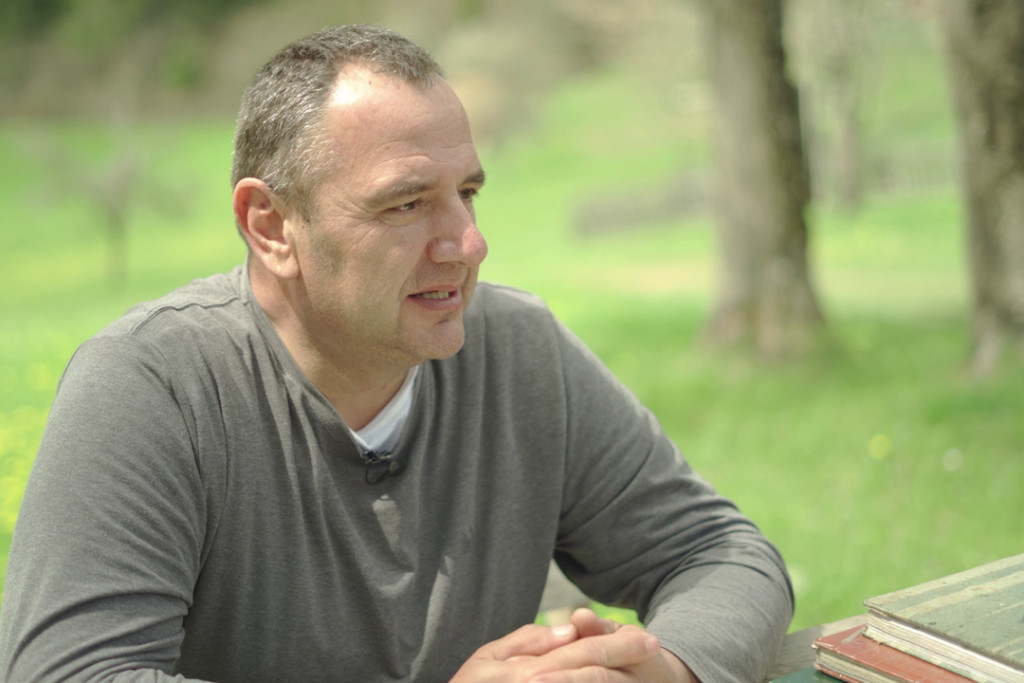
"To tell you the truth," our host begins, "I'm an amateur beekeeper, I don't live off bees, but bees are a big hobby of mine. Was it a legacy I inherited from my grandfather, or did I fall in love with it all on my own? Well, I hadn’t planned to be a beekeeper, but that's how it began, and it continues to this day. There have been ups and there have been downs."
Almir practices stationary beekeeping and does not move his hives to other forages. Instead, he tries to prepare them for June, when the meadow is full of flowers and when the conifers start producing nectar. The peak bee population is reached at the end of May and the beginning of June.
Bees communicate, he claims. "When a bee finds a plant somewhere it returns to the hive and performs a little dance giving the exact coordinates of the plant to other bees."
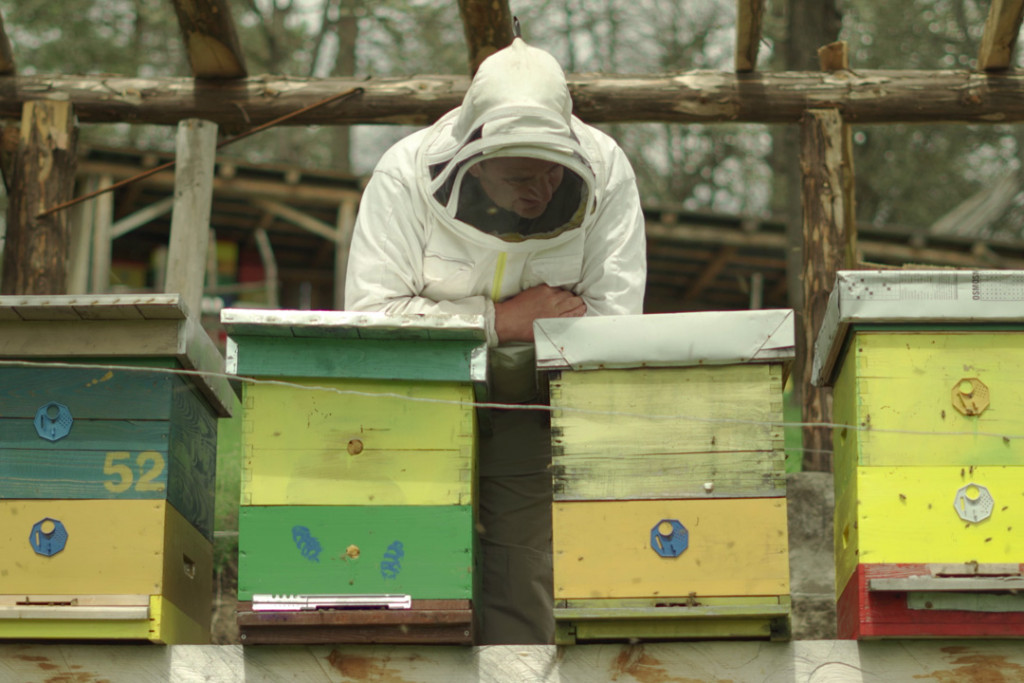
All these years, Almir has been keeping a journal. Every time he goes to the apiary, he takes his diary with him recording basic information about the hives, changes in the colonies, the vegetation, harvesting honey... Whenever he is in the apiary, the journal is there with him.
"You see," he continues, "the diary helps me compare this year with the last, with the one before last, with any previous year, to compare the periods when plants give most nectar. So you can use this past experience to better plan in the present. I always write down general observations about anything and everything that’s within a five kilometres’ radius of the beehives. That's the distance my bees cover and that's what I’m interested in. I try to write down what is important for the life and work of bees in that area".
The journal is full of precious entries for him. And when he analyses what he has recorded, it seems to him that the ecosystem in which he lives changes from year to year.
There are no smooth transitions
He notices that there are no more gentle transitions from warm to cold season and vice versa. "It's like someone’s cutting it off with scissors. Snow, snow, snow, and then all of a sudden, it’s plus 40. When I think back to my childhood, I used to go out running in the rain. The rain was warm in the summer. Nowadays, as soon as the sky is cloudy, you have to put your coat on. We don't have time to adapt - neither we, nor the bees".
It's eighteen and a half degrees, bees are buzzing above our heads and around our feet, no wind. If you are not in the shade, the sun is still beating down on you hard. The previous days dawned with frost here, "and every frost at this time of year disturbs the grass, it burns it".
This is the period when pollen is a priority for the development of bees. "Bee, the poor thing, will go out to collect pollen, it will load the maximum cargo on its legs, and then on the way back to the hive, a sudden wind knocks the bee down. And when it knocks it down, the bee no longer has the strength to get up. That bee and its cargo, which is so important for the growth of bees, are lost."
And so, bee after bee is lost.
This happens, he explains, because we don't have stable weather - periods of rain, periods of clear skies – instead, the weather turns suddenly. "That's what I’ve noticed," he says, "I may be wrong, but that's what I see and witness."
Bees have existed for 150 million years. There are over 10,000 species of bees in the world. Around 50,000 bees can live in one hive. Worker bees can reach a speed of about 15 kilometres per hour. A bee flaps its wings 11,400 times a minute. It can distinguish hundreds of different plant species with its sense of smell. A bee pollinates up to 100,000 flowers in one summer. One colony has up to 80,000 bees.
Global pollinator crisis
About 500 meters away from the apiary is a belt of coniferous forest, and what these bees bring to their hives at the beginning of summer will mostly be from those trees. However, in the last ten years, even this forest is not as nectar rich as it was before.
There was a big drought in 2012. In its wake, the nectar harvesting from spruce has been significantly reduced for some years.
Almir asked experts what was happening. They explained to him that the system the plant uses to draw moisture from soil was damaged and it can’t absorb sufficient amounts of water regardless of the frequency of rainfall. "Thus, our spruce trees get damaged, and there appear half a hectare or a hectare-wide belts of dead trees in the middle of the forest. The forest is in danger, and therefore our bees as well".
For pollination to take place in nature there has to be some sort of external intervention and most often this is done by bees. This is why they are such an important part of this planet.
For the last fifty years, we have been witnessing a phenomenon that experts call the global pollination crisis. Many scientific studies indicate that the number of bees in the world is drastically decreasing. A reduction in the number of bees can lead to the reduction, even loss, of many species of plants, as well as the organisms that directly or indirectly depend on them.
"We are to blame. We humans are… is there anything we haven't messed up? We spoilt water at the well. You come to the well, and the water is not safe to drink. When these cracks appear in the ecosystem, they spread. Like a tower of cards - the first card falls, then the second, the third, until it collapses, and it's our fault. Everywhere we look it’s discard this, fly tip that, throw out, destroy, burn... And then we wonder why things are as they are".
Bees not only give us food, but beekeeping is also an industry worth, according to some estimates, over five hundred billion dollars.
People and conscience
Studies reveal some reasons why bees are dying: we cut down forests excessively and reduce green areas, we use pesticides that cause poisoning, diseases have developed to which bees are not immune, climate change affects the behaviour of bees.
In these parts, beekeepers often accuse raspberry growers for recklessly treating plants with chemicals, which adversely affects bees.
Almir says that raspberries didn’t take in this area, and that there are no raspberry growers here. Although, according to him, they and beekeepers should exist in harmony, because they need each other. "Pesticides, herbicides, there are no such things here. You know, the main problem stems from lack of communication between raspberry growers and beekeepers. If a raspberry grower treats his plants, then the beekeeper must close his hives during that period to prevent poisoning. After all, we all live from our businesses. The beekeeper from his, and the raspberry grower from his, and everyone tries to earn as much as possible. And that's fine, but we must communicate."
He remembers what it was like when he was a child.
"In those days, when forestry was going to spray the forest, they would put up notices on notice boards informing people when and where they would spray the forest... And beekeepers? They would stick a piece of sponge in the beehive entrance and keep it there for three days. It was a centralized system and orders were issued; those who wouldn’t obey were punished. Now it's all left to our conscience, but by God, conscience and people are not in a very good relationship".
Our host leaves through his journals. He shows us interesting data for previous springs. We find that morning temperatures were as low as minus seven, and daytime temperatures went up to plus twenty. One year it snowed after the trees blossomed and the snow cover lasted for three days. The journal says that three years ago, two bears broke into his apiary. They smashed one hive and ate the honey.
"Bears are gentlemen," he says as he reads the diary, "they break one beehive, eat their fill and leave."
Something is happening
Something is happening, he concludes, nature is changing. "Now, how big those changes are and whether the weather used to be like this before my time, I don't know. Each year is different, and each year brings sudden changes in weather".
And this is felt the most in spring and early summer. This period is the most important for bees.
The bee lives on the wax it makes, it feeds on honey and bee bread it produces. Honey gives energy, and pollen contains acids, vitamins and everything else the bee needs to develop properly. Without honey and pollen, there are no healthy bees.
"Wintering is over; the food stores the bees had are running out. When spring comes, the beekeeper can give them sugar syrup to bridge the gap until the weather is warm enough, but you cannot replace pollen. If there is no pollen in the hive, it’s over. In early spring, if nature does not provide sufficiently, the bees will perish one by one until the colony weakens, disappears into the abyss".
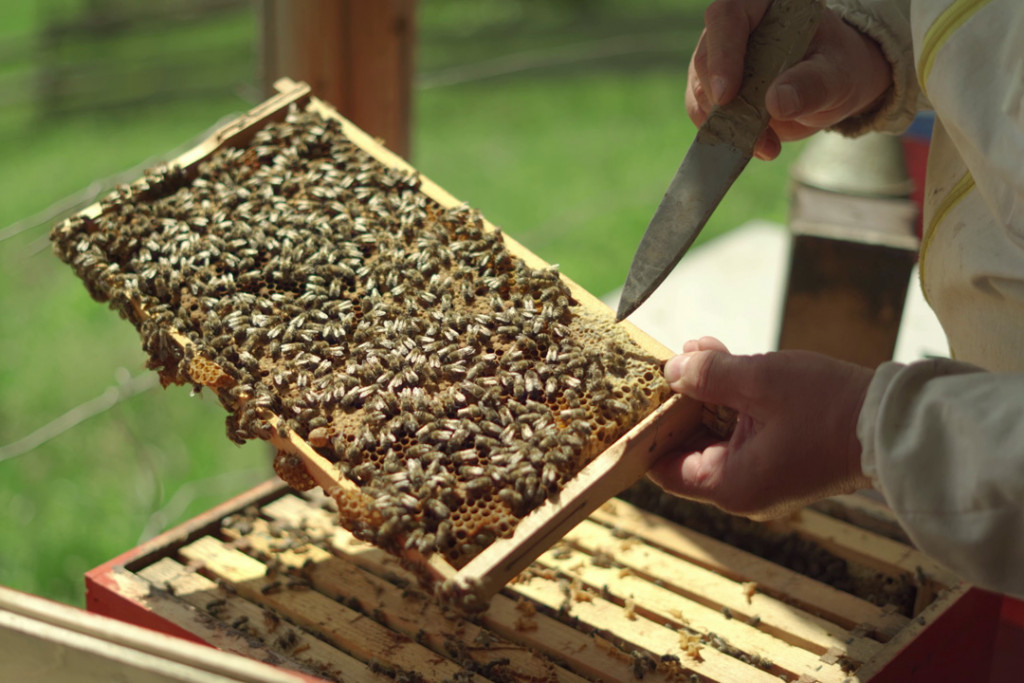
Almir greets the bees. He doused his hands with vinegar and opens the crates and takes out the frames covered with vibrating bees. His movements are calm. There are no sudden moves; each one is measured, as if it had been repeated a thousand times.
As Maurice Maeterlinck wrote in 1901 “No living creature, not even man, has achieved, in the centre of his sphere, what the bee has achieved in her own; and were some one from another world to descend and ask of the earth the most perfect creation of the logic of life, we should needs have to offer the humble comb of honey".
In Europe, the number of bees has decreased by three quarters in the last 30 years. In our country, it is increasingly rare to find colonies of bees hidden in the trunk of a tree or in a cave that will survive these climate upheavals on their own. Are we aware where this trend is leading to and are we planning to do something?